Why Some Outfits Are Too Loud for a Quiet Theater

Quick Answer: Nylon and polyester shells with a tight weave and a coating - puffer jackets, rain shells, technical outerwear - produce a high-frequency rustle that cuts through a quiet room, because their stiff fibres slide against each other rather than deforming. Cotton, wool, fleece, and knits are quiet because the fibres compress instead. For a theater, choose fleece or knit warmth over a packable shell, and put anything crinkly under the seat before the film starts.
The warmest packable layer is almost always the loudest one.

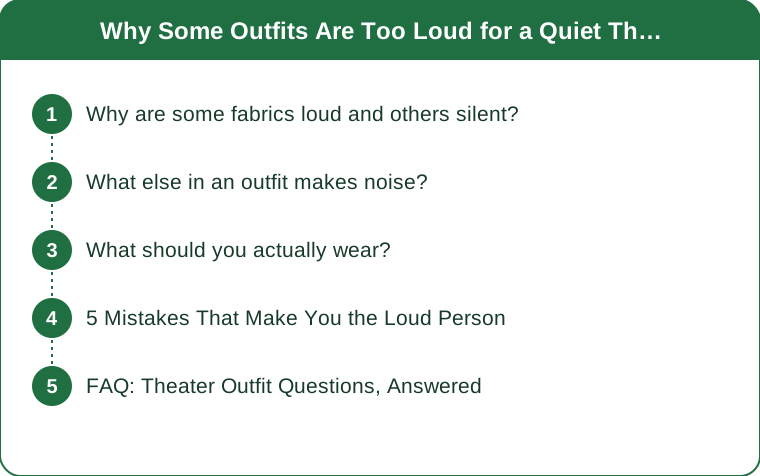
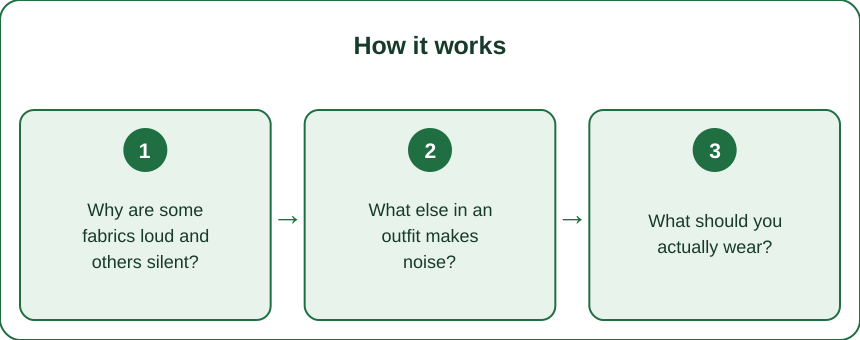
Why are some fabrics loud and others silent?
It comes down to fibre stiffness and surface friction, and the same properties that make a jacket warm and packable make it noisy.
Sound from fabric is generated when two surfaces slide across each other and release in rapid micro-slips - a sequence of tiny snaps that the ear perceives as a rustle. How loud that is depends on three things.
Fibre stiffness. Nylon and polyester filaments are smooth, stiff, and elastic. When they bend they snap back rather than deforming, and each snap-back releases energy as sound. Cotton and wool fibres are softer and crimped - they deform and absorb the energy instead.
Surface finish. Water-repellent coatings, ripstop treatments, and calendered finishes all make the surface harder and smoother, increasing both the friction snap and the efficiency with which it radiates sound. A coated shell is meaningfully louder than the same fabric uncoated.
Structure. A tightly woven fabric transmits vibration efficiently, like a drum head. A knit or a fleece is full of air and dead space, which absorbs vibration rather than radiating it.
A rough loudness ranking, quietest to loudest:
- Silent: fleece, thick knits, jersey, brushed cotton, wool, corduroy
- Quiet: cotton twill, denim, linen, flannel, most woven cotton shirts
- Noticeable: taffeta lining, satin, thin polyester blouses
- Loud: nylon shells, rain jackets, packable down and puffer jackets, technical fabrics, anything ripstop
The frequency is what makes it carry. Fabric rustle sits in a high-frequency band, roughly 2 to 8 kHz, which is precisely where human hearing is most sensitive - and where a film’s quiet dialogue scenes have the least masking content. That is why a rustle is inaudible in the loud scenes and unmistakable in the quiet ones. Your jacket is not louder during the quiet parts; there is simply nothing covering it.
What else in an outfit makes noise?
More than the jacket, and some of it is easy to miss.
Hardware. Zip pulls tapping against zip teeth, buckles, D-rings on a bag, and coins in a pocket. A single loose zip pull on a jacket draped over a seat is a recurring click for two hours, and it is one of the most common sources.
Jewellery. Bangles and layered chains, particularly on the arm you rest on the armrest.
Bag material. A nylon tote or a coated shopper is as loud as a jacket, and it gets moved more often - every time you reach for something.
Packaging. Not clothing, but the same physics. Foil and cellophane wrappers are the loudest thing anyone brings into a cinema, for exactly the reason above: stiff, coated, high-frequency. Open anything before the film starts.
Footwear on the floor. Hard soles scraping on a concrete or sticky floor, and heel taps.
Seat interaction. Leather and vinyl recliner seats squeak against synthetic fabrics far more than against cotton. A nylon-clad person on a vinyl seat squeaks every time they shift, and it is a combination effect rather than a property of either surface alone.
The cumulative point: most of the noise comes from things you move, not things you wear passively. A loud jacket on the seat back is quiet; a loud jacket you are wearing while shifting position is not. Which suggests the practical fix is less about buying different clothes and more about where things end up once you sit down.

What should you actually wear?
Warm, quiet, and layered so the warmth is adjustable without a shell.
The core principle: get your warmth from fleece and knit rather than from a shell. Theaters run cold - typically several degrees below normal indoor temperature, because projection equipment and full rooms generate heat that the system is sized to remove - so warmth is genuinely needed. A fleece layer is as warm as a light puffer for cinema purposes and is completely silent.
A working formula for the current late-summer-into-fall stretch:
- Base: a soft cotton or modal long-sleeve tee. Quiet, breathable, comfortable against a seat.
- Mid: a knit cardigan or fleece zip. This is the layer doing the actual work, and both are silent.
- Outer, for outside only: whatever jacket the weather requires. Take it off and put it under the seat or behind your back before the film starts rather than draping it where you will move it.
- Bottom: knit trousers, jeans, or a heavy legging. Avoid nylon-shelled or technical trousers, which squeak against vinyl seats.
- Feet: proper socks. Feet get cold first in a theater because the floor is cold and there is a constant floor-level draft from the ventilation.
- Extra: a large scarf or pashmina in wool or knit, which doubles as a blanket and is silent.
Things to leave out: packable puffers as your only warm layer, rain shells worn indoors, anything with dangling hardware, bangles on the armrest arm, and hard-soled shoes if you are likely to move.
Two habits that matter more than the clothes. Sort yourself out before the trailers end - jacket stowed, snacks opened, bag settled, phone silenced. The single loudest moment of most cinema trips is someone rearranging in the first quiet scene. And put the loud item somewhere you will not touch it, which usually means under the seat rather than on your lap or over the seat back.
5 Mistakes That Make You the Loud Person
1. Wearing the puffer as your warm layer. It is the warmest thing per gram and the loudest thing per movement. Bring it for outside, wear fleece inside.
2. Draping the jacket over your lap. Every shift moves it, and you shift more than you think over two hours. Under the seat is silent.
3. Opening snacks after the film starts. Foil and cellophane sit exactly in the frequency band where hearing is most sensitive, and the quiet scenes have nothing to mask them. Open everything during the trailers.
4. Bringing a nylon tote. It gets moved every time you reach into it, and it is as loud as any jacket.
5. Underdressing and then needing the loud layer. Being cold means fidgeting, which is itself noise, and it means reaching for the shell mid-film. Dress warm enough at the start with quiet fabrics and you stop moving entirely.
FAQ: Theater Outfit Questions, Answered
Are all puffer jackets loud?
Most are, because the shell is coated nylon. Some use a soft-touch or brushed shell that is substantially quieter - worth checking by scrunching a sleeve in the shop, which is a reliable two second test.
Why do theaters run so cold?
A full auditorium plus projection equipment generates significant heat, so the system is sized for a full house. In a half-empty screening it overcools, which is why quiet showings are the coldest.
Is a blanket acceptable to bring?
Most cinemas do not mind a large scarf or wrap. A knit or wool one is silent, unlike a fleece throw in a nylon stuff sack.
What is the quietest warm fabric?
Fleece and thick knit wool. Both trap air, both absorb vibration rather than radiating it, and neither has a coated surface.
Does it matter what shoes I wear?
Hard soles scrape on cinema floors and heel taps carry. Soft-soled shoes are quieter, and they also make getting to a middle seat less disruptive.
TL;DR:
- Coated nylon and polyester shells rustle because stiff fibres snap back rather than deforming; fleece, knit, and cotton absorb the energy instead.
- Fabric rustle sits at 2 to 8 kHz, exactly where hearing is most sensitive and where quiet dialogue offers no masking.
- Get warmth from fleece and knits, and treat any shell as an outdoor-only layer.
- Stow the loud item under the seat, not on your lap, and open everything during the trailers.
- Zip pulls, bangles, nylon totes, and hard soles account for more noise than the jacket you are wearing still.
Scrunch a sleeve in the shop before you buy. Two seconds tells you everything.
Keep Reading
This article is for general informational and styling purposes only. Fit, sizing, and product availability may vary.