What to Wear to an Outdoor Movie Screening in Late Summer

Quick Answer: Dress for the temperature two hours after sunset, not for the temperature when you arrive. That usually means a base you are slightly too warm in on arrival, a mid layer you can add at dusk, and something for the ground — a blanket plus a cushion, since grass pulls heat from below faster than the air does. Closed shoes and long or convertible bottoms handle insects, which are the second most common complaint after cold.
Outdoor screenings run three to four hours from arrival to end, across the single fastest temperature drop of the day. Very few outfits are designed to work across a 20-degree swing while you sit still on the ground.
How much does the temperature actually drop?
More than most people plan for.
In late August in most of the northern US, the drop from a 7pm arrival to a 10pm finish runs 15 to 22 degrees Fahrenheit. Clear skies make it worse — cloud cover traps heat, so the most beautiful screening nights are the coldest ones.
Grass and open parkland are colder than paved areas by several degrees, because hard surfaces release heat they absorbed during the day and grass does not. A screening in a park will be noticeably cooler than the same night on a rooftop.
The ground is the biggest factor and the one people ignore entirely. Sitting on grass conducts heat away from your body far faster than the air convects it. You can be comfortably dressed for 62F air and still be cold within an hour because your entire underside is in contact with something colder.
Humidity adds to the perception. As the air cools, relative humidity rises and dew forms, so the blanket you sat on at 7pm is genuinely damp by 9:30.
What is the right layering structure?
Three layers, with the third staying in a bag until you need it.
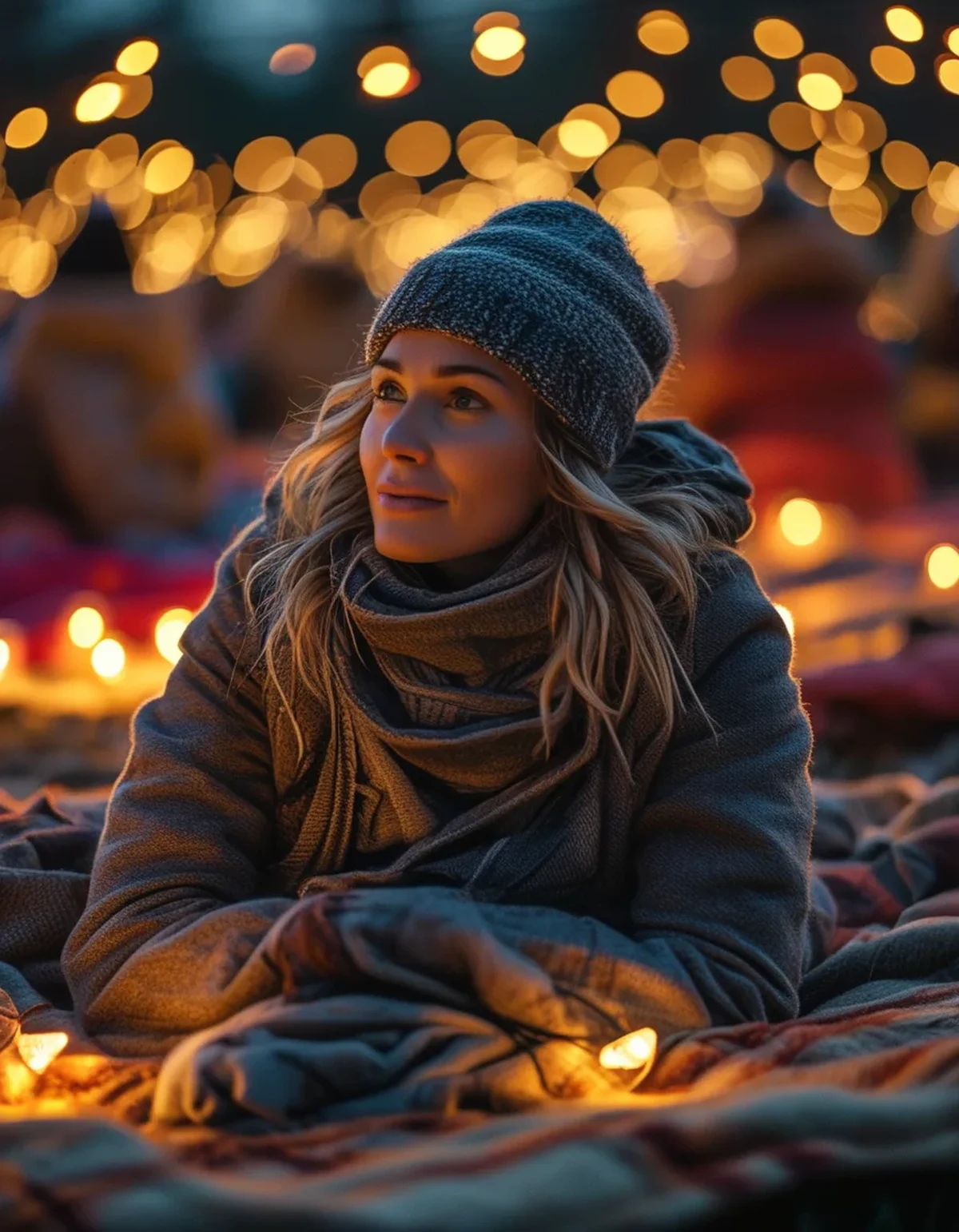
Base: something breathable you are comfortable in at arrival temperature. A cotton or linen-blend tee, a tank, a light knit. You will be warm for the first hour and that is correct.
Mid: a long-sleeve layer that goes on around sunset. An overshirt, a light cardigan, a crew sweatshirt. This is the layer doing most of the work, and it should be easy to put on while sitting down — which rules out anything you have to pull over your head awkwardly in the dark.
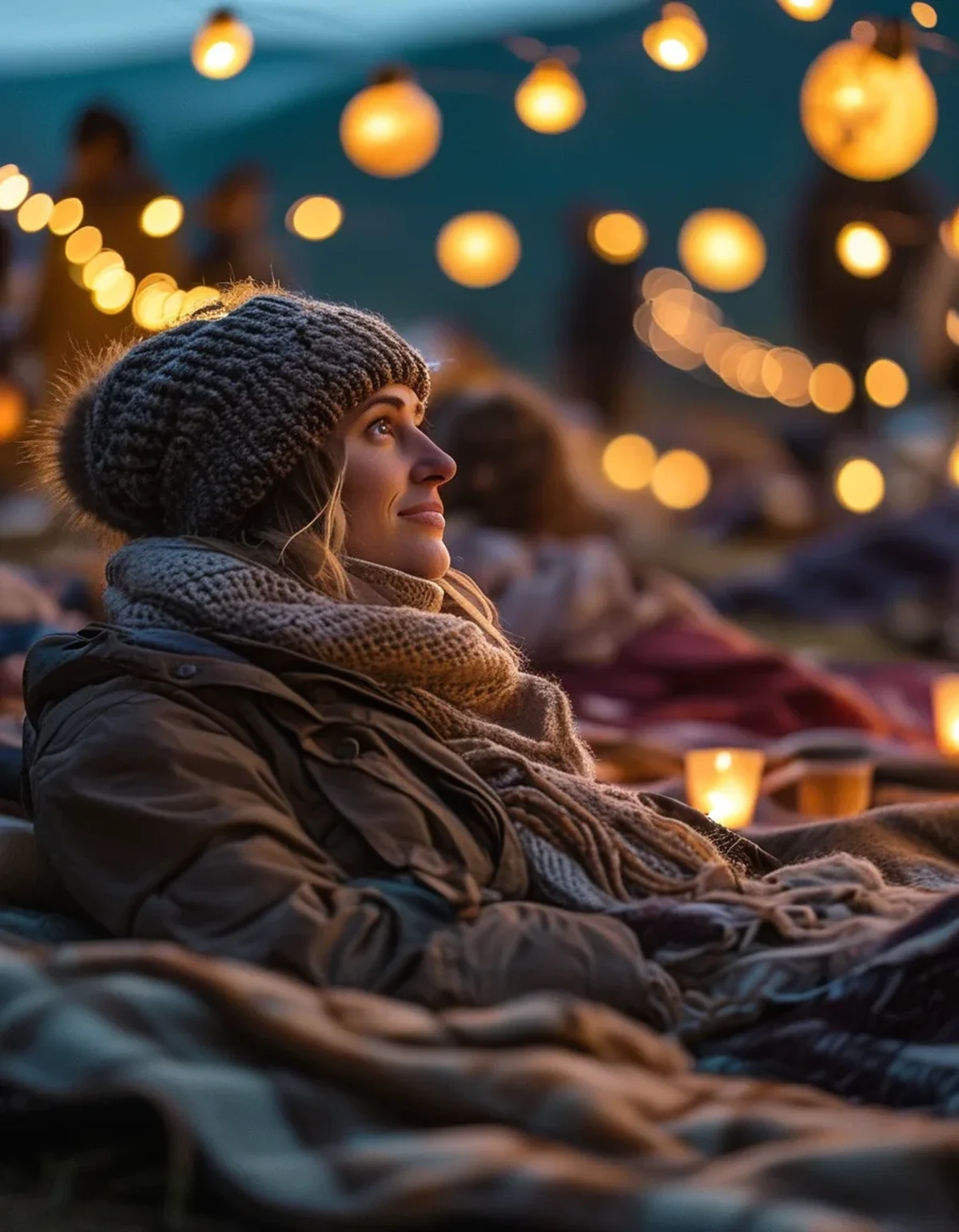
Outer: a packable jacket or a large scarf for the last hour. A scarf is often better than a jacket here because it can also go over your legs, and legs get cold first when you are seated.
On the bottom, a wide-leg trouser or a long skirt beats shorts for this occasion. It covers your legs against both cold and insects, and it is more comfortable to sit cross-legged in than a fitted jean.
Bring one more thing than you think you need. Carrying an unused layer costs nothing; being cold for the last 45 minutes ruins the film.
What should you sit on?
Two items, and neither is optional.
A ground barrier. A waterproof-backed picnic blanket, or a plain blanket over a tarp. Grass at 9pm is damp regardless of whether it rained, and a cotton blanket alone wicks that moisture straight through to you.
Something to sit on top of that. A cushion, a folded second blanket, or a stadium seat. This is about insulation and about your back — three hours sitting flat on the ground with no support is genuinely uncomfortable for most adults over thirty.
Low-back camping chairs are permitted at many outdoor screenings and banned at others because they block sightlines. Check the venue rules before packing one, and if chairs are allowed, a low beach-height chair is usually the requirement.
A third blanket, purely for putting over your legs, is the single most appreciated item anyone brings. It weighs almost nothing and it is what turns the last hour from endurable to pleasant.
If you are cycling or walking in, a compressible down or synthetic throw packs to the size of a water bottle and solves the bulk problem entirely.
5 Mistakes People Make at Outdoor Screenings
1. Wearing sandals. Grass is damp, insects are at ankle height, and your feet are the first thing to get cold when you are sitting still. Closed shoes with socks, even when it feels excessive at arrival.
2. Bringing a jacket but no leg covering. Your upper body is easy to insulate and your legs are what actually gets cold when seated. A blanket over the legs beats a warmer jacket every time.
3. Underestimating insects. Dusk near grass and water is peak mosquito activity. Long sleeves and long bottoms plus repellent on any exposed skin, applied before you sit down rather than after the first bite.
4. Choosing a light-colored blanket. Grass stains, dew marks, and spilled drinks are all permanent on a pale picnic blanket. Darker or patterned survives a summer of use.
5. Dressing for photos rather than three hours on the ground. The rooftop screening version of this occasion supports a nicer outfit; a park screening does not. Know which one you are attending before choosing what to wear.
What about rooftop and drive-in screenings?
Different venues, meaningfully different requirements.
Rooftop screenings are warmer at ground level — the building has been absorbing heat all day and releases it upward — but far windier. Wind is the dominant factor, so a windproof outer layer matters more than a warm one, and anything loose becomes a hassle. Seating is usually provided, so the ground layer problem disappears. These venues also skew dressier, and closed shoes with a proper outfit works well.
Drive-ins remove the temperature problem almost entirely if you stay in the car, which means comfort is the only consideration. If you sit outside the car or in a truck bed, you are back to the park screening rules with the addition of a hard surface, so cushioning matters more than insulation.
Beach or waterfront screenings are the coldest of all. Water holds temperature differently from land and the onshore breeze after sunset is reliably cold. Treat these as an autumn evening regardless of the daytime forecast, and bring the extra layer you would leave at home for a park.
As September arrives, all of these get colder faster. The screenings in three weeks will need genuinely warm clothing, not just a cardigan — the season for a light layer being sufficient is closing.
FAQ: Outdoor Screening Questions, Answered
What time should I actually dress for?
About two hours after sunset. Look up the sunset time for the date, add two hours, and check the forecast temperature for that hour. That is the number that determines whether you enjoy the last act.
Is a blanket enough or do I need a jacket too?
Both, if the evening low is under about 65F. A blanket handles the legs and a jacket handles the core, and neither substitutes for the other when you are sitting still for three hours.
How do I stay comfortable without carrying a huge bag?
A packable jacket, a compressible throw, and a tote that doubles as a cushion when stuffed with the layers you have not put on yet. Everything you bring should have a second use, which is what keeps the load reasonable.
TL;DR:
- Dress for two hours after sunset — the drop from arrival to credits is typically 15 to 22F.
- Three layers: breathable base, mid layer for dusk, packable outer or scarf for the last hour.
- The ground matters more than the air: waterproof barrier, something to sit on, and a separate blanket for your legs.
- Closed shoes and long bottoms handle both the cold and the insects.
Check the sunset time before you leave and pack one more layer than seems necessary. Nobody has ever regretted the extra blanket at an outdoor screening.
Keep Reading
This article is for general informational and styling purposes only. Fit, sizing, and product availability may vary.