What to Wear to a Freezing Movie Theater When It's 90 Degrees Outside

Quick Answer: Theaters run cold on purpose — full auditoriums generate serious body heat, so systems are set for the room at capacity, which means a half-empty Tuesday showing sits in the low condition range while you sit still for two-plus hours generating almost no heat of your own. The fix is a three-part system: a breathable summer base for the parking lot, a real mid-layer that packs small (not a token shrug), and covered extremities — closed shoes, long bottoms or a lap layer, and something for your neck. Dress for the two sedentary hours, not the ten-minute walk in.
Everyone has done the August theater shiver: in by choice, trapped by ticket price, spending the third act thinking about the sweatshirt at home. The 25-degree swing between sidewalk and seat D14 is one of summer’s most predictable wardrobe problems — and one layer choice away from solved.

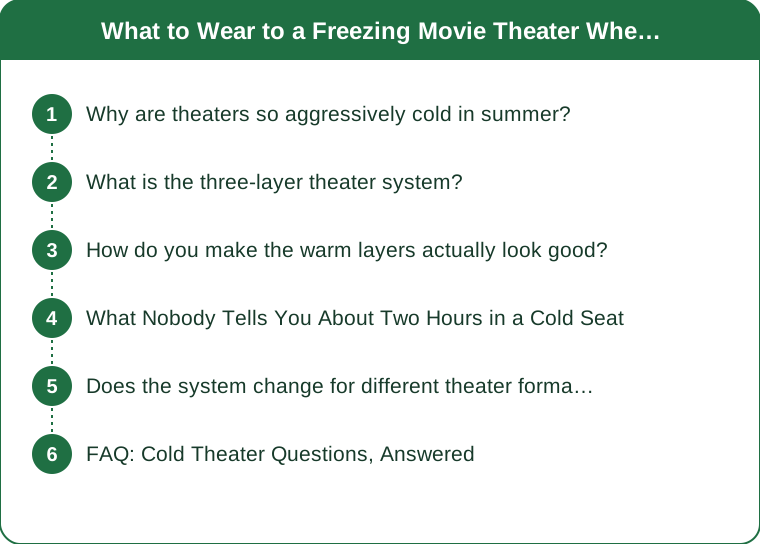
Why are theaters so aggressively cold in summer?
Because the thermostat is set for a full house, and you rarely attend one.
A packed auditorium is a heat engine — a couple hundred bodies each radiating roughly the output of a small space heater. Cooling systems are specified to hold a sold-out Saturday premiere at a comfortable temperature, which means the setpoint assumes hundreds of warm bodies helping. Walk into a quarter-full weekday matinee and the same system is fighting a heat load that never showed up; the empty seats do not shiver, but you do.
Your own physiology finishes the job. Sitting nearly motionless for two hours drops your metabolic heat production to its daytime floor — no muscle activity means no internal furnace — and skin temperature drifts down accordingly. Add the cold-air-sinks problem (auditorium vents dump chilled air from above, and it pools through the seating bowl) plus the post-sweat effect, where the light sweat from the hot walk over evaporates in the dry conditioned air and chills you double, and the meat-locker experience explains itself.
It also varies inside one building: seats directly under vents and along aisles run coldest, the center of a crowded row runs warmest — other people are radiators — and older multiplexes with one big system swing harder than newer ones with zoned control. Which is why the friend who says that theater is fine and the friend who brings a blanket are both telling the truth.
What is the three-layer theater system?
One principle — dress for the seat, carry for the sidewalk — executed in three parts.
Base: real summer clothes, slightly upgraded. A breathable tee, tank, or summer knit handles the walk and the lobby. The upgrade is fabric: a base with some substance (a heavier cotton, a rib knit) beats a gauze-thin top, because the base is your only layer for the first ten warm minutes and your foundation for the cold two hours.
Mid: the actual insulation, chosen for packability. This is where most outfits fail — a decorative shrug is not a thermal layer. What works: a full cardigan in a real knit, a zip hoodie, a light bomber, or an oversized overshirt. What works best: whatever compresses smallest into a bag, because you will carry it through the hot part. The zip or button front matters — theaters warm up as they fill, and adjustability beats commitment.
Extremities: where the cold actually gets in. Long bottoms beat shorts by a wide margin — two hours of chilled air on bare legs is the core of the theater-shiver experience, and soft full-length pants or leggings are the single highest-value swap in the whole system. Closed shoes with low socks beat sandals for the same reason. And a light scarf or the hood of that hoodie covers the neck, which is disproportionately where sitting-still cold registers.
Assembled: summer top, packable warm layer in the bag, long soft bottoms, closed shoes. Sidewalk-appropriate, seat-proof, and nothing about it reads as carrying winter through August.
How do you make the warm layers actually look good?
Treat the mid-layer as the outfit’s main character instead of its apology.
The theater is a dim, seated, casual venue — which means texture and silhouette do all the style work, and color does almost none after the lights drop. An outfit built as fitted base plus voluminous layer plus tapered bottom reads deliberate in any combination: ribbed tank under an oversized cardigan over slim dark joggers; fitted tee under a bomber over full-length leggings; summer dress with a real hoodie and sneakers, which is the underrated three-piece of casual summer evenings.
The leggings route deserves its specific mention because it wins this venue so completely: a dark pair of buttery-soft leggings is the only bottom that is simultaneously sidewalk-fine in heat, warm enough for the auditorium, and comfortable through a 140-minute runtime plus trailers — the movie-theater trifecta no woven pant manages. With an oversized layer on top, it is also simply a good outfit.
Date-night versions keep the system and upgrade the materials: the knit becomes a fine-gauge sweater, the joggers become ponte pants, the sneakers become loafers with socks. The one date-night mistake is abandoning the system for a strappy-top-and-sandals look that spends acts two and three huddled — cold is not a romantic aesthetic.
And dark colors earn their keep here beyond slimming folklore: theater seats, popcorn butter, and dropped candy are a fabric hazard environment, and a black or deep-navy outfit exits the auditorium with its secrets intact.

What Nobody Tells You About Two Hours in a Cold Seat
The chill compounds through the runtime — minute 100 is measurably colder than minute 20, because your sedentary body keeps ratcheting down while the room holds steady. The layer that felt unnecessary during the trailers is the one you want by the climax, which argues for bringing it to the seat even when the lobby felt fine. Put it on slightly before you feel cold; staying warm is cheap, getting warm back in a cold room while motionless is slow.
The post-sweat chill is worth beating deliberately on real heat-wave days: arrive five minutes early, and let yourself finish sweating in the lobby before entering the auditorium. Sitting down damp in 68-degree air is how a mild chill becomes a shivering third act — a paper napkin blot and two lobby minutes prevent it entirely.
Seat selection is climate control nobody uses: center-of-row runs warmer than aisle, mid-bowl beats under-the-vent rows (glance up when choosing reserved seats — vents are visible on the seat map’s ceiling in person), and a crowded showing is genuinely several degrees warmer than an empty one. The Tuesday-night empty-theater luxury has a thermal tax.
The blanket-scarf — a scarf sized to function as a lap layer — is the veteran move that looks like an accessory and works like equipment, and it is why frequent theatergoers seem mysteriously comfortable. In its absence, the mid-layer worn backward over the front, duvet-style, is the emergency version everyone eventually discovers on their own.
And hold the icy drink in mind as a thermal decision: a 32-ounce iced soda is a cold press against your core for an hour. Room-temperature water or a hot tea from the cafe counter changes the whole equation.
Does the system change for different theater formats?
The principle holds; the calibration shifts by venue.
Premium recliner theaters run warmer-feeling than standard auditoriums — the padded recliners insulate your back half, and smaller boutique rooms cycle less air per person. The full system still comes along, but the mid-layer may stay in the bag. The recliner-specific note: a footrest position exposes your ankles to the floor-level cold layer, which is the closed-shoes-and-socks argument restated.
IMAX and large-format rooms are the cold end — big volumes, tall ceilings, powerful systems, longer runtimes. This is full-system territory: the real mid-layer, the neck cover, the lap-capable scarf. Marathon screenings and three-hour epics compound the sedentary drift; dress for the last hour, not the first.
Dine-in theaters add the meal variable, which helps — digestion generates a little heat, and hot food beats the iced-soda problem — but service means your arms are out and active over a table, so a layer with sleeves beats a draped one.
Outdoor summer screenings invert everything: warm start, genuinely cool finish after sunset, plus ground chill from below. That is its own packing list — blanket down, layer up, bug spray — and the one venue where the winter-through-August accusation is simply true and correct.
Across all of them, the bag requirement stays constant: whatever holds the packed layer needs to ride your shoulder hands-free, because the hands are committed to tickets, phone, and the popcorn that started this whole evening.
FAQ: Cold Theater Questions, Answered
Can I just ask the theater to turn the AC down?
You can mention it at guest services, and in small independent theaters it occasionally works — but multiplex systems are zoned and scheduled centrally, and mid-showing adjustments are rare. The staff wearing fleeces in August is your answer about who controls the thermostat. Self-sufficiency via layers has a 100 percent success rate; the request has a lottery ticket’s.
Why do I get colder at the movies than my partner does?
Bodies differ in cold perception along size, muscle mass, and circulation lines — smaller frames and lower muscle mass lose heat faster while sitting still, and research on office thermal comfort consistently finds the standard setpoints run colder than many women’s comfort range. It is physiology, not toughness; calibrate your own layer count and ignore the comparison.
What about matinees versus evening shows — any thermal difference?
Matinees tend emptier, which means colder (fewer bodies helping), while the building itself is fighting peak outdoor heat — systems often overshoot hardest in the early afternoon. Evening crowds warm the room noticeably. The coldest ticket in the multiplex is the 1pm Tuesday showing of a movie in week six; dress accordingly.
Is there a minimal version for people who refuse to carry a bag?
Wear the system instead of packing it: full-length soft bottoms, closed shoes, and a tie-capable overshirt or hoodie around the waist on the walk over. The waist-tie is the carry. It limits you to one layer, so spend it well — sleeves and a front zip, nothing decorative.
TL;DR:
- Theaters are set for full houses; empty showings plus two sedentary hours equals a real chill regardless of the heat outside.
- System: breathable base for the walk, packable real mid-layer (zip or button front), long soft bottoms, closed shoes, something for the neck.
- Dark leggings plus fitted base plus oversized knit is the venue’s ideal outfit — sidewalk-proof, seat-proof, popcorn-proof.
- Refine with veteran moves: dry off before entering, sit center-row away from vents, layer up before you feel cold, skip the iced-drink core chill.
Put one packable layer and a big scarf in the bag you already bring, and the third-act shiver retires permanently. The movie should be the only thing giving you chills — and for the price of tickets lately, you deserve to feel your feet through the credits.
See It in Motion
Seen here: High Waist Embossed Yoga Leggings with Side Pockets — shop it on bubblelime.com
Keep Reading
This article is for general informational and styling purposes only. Fit, sizing, and product availability may vary.